![[personal profile]](https://www.dreamwidth.org/img/silk/identity/user.png) james_davis_nicoll
james_davis_nicollSuppose it's the future and further suppose that space tourism actually takes off enough that there are excursions to the Moon akin to what we see in Antarctica. Although probably not the 37,000 people a year you see headed to Antarctica because going to the Moon is going to a crapton more expensive.
Further, suppose
it occurs to someone whose life centers on ferrying rich bastards back and forth to the Moon that the delta vee to go from Low Earth Orbit (LEO) to Low Lunar Orbit (LLO) is about 8 km/s. It's the same the other way, assuming no aerobraking at the Earth end (No aerobraking at the Earth end means big mass ratios or some kind of fuel depot in LLO). That's considerably more delta vee than it takes to to Mars from the Moon and it further occurs to them it might be fun on the next trip home to leave the tourists on the Moon and take an unsheduled excursion to Mars.
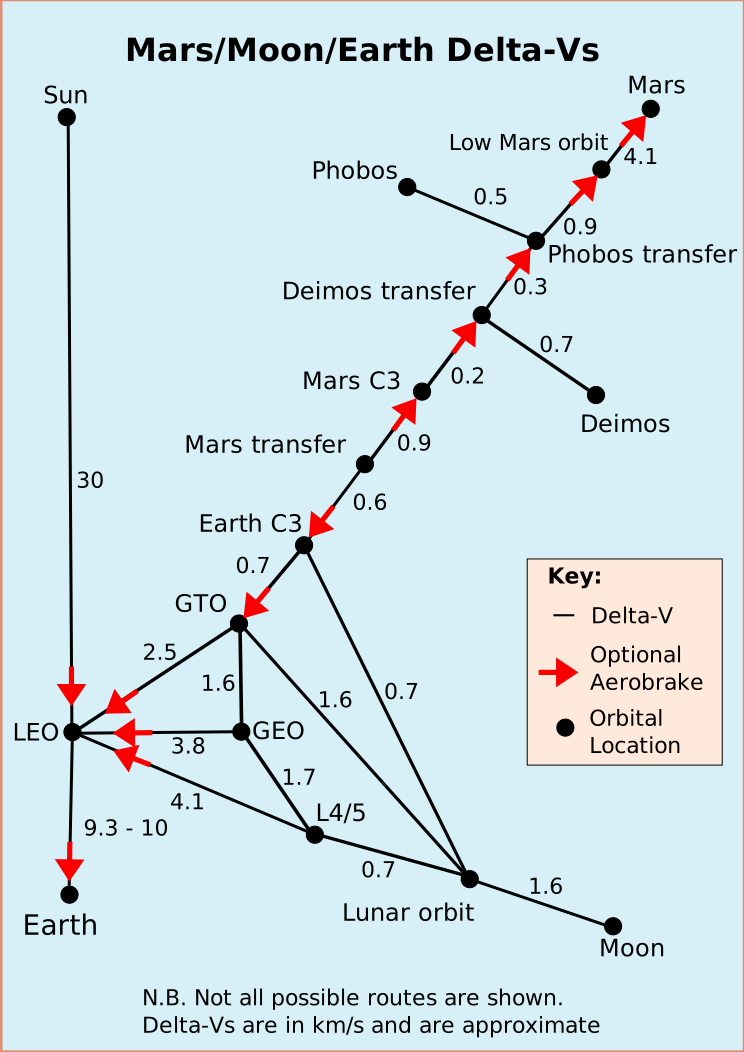
How would you go about adapting a vehicle designed to do the LEO-LLO trip to a LLO-Mars trip?
The first big issue is going to be air. Assuming a dozen passengers and three crew, and about a week to the Moon and back, the ship probably doesn't have more than 105 person-days of O2. Fast but still reasonably delta-vee conservative orbit to Mars is about 180 days.
I suppose, this being fiction, you could do it the other way: the would-be Marsnaut needs 180 person-days, therefore the LEO-LLO transfer ship carries a couple of dozen passengers and some crew. That will at least get the Marsnaut to Mars alive.
This is all a lot easier if the pilot doesn't plan on surviving long enough to return.
Further, suppose
it occurs to someone whose life centers on ferrying rich bastards back and forth to the Moon that the delta vee to go from Low Earth Orbit (LEO) to Low Lunar Orbit (LLO) is about 8 km/s. It's the same the other way, assuming no aerobraking at the Earth end (No aerobraking at the Earth end means big mass ratios or some kind of fuel depot in LLO). That's considerably more delta vee than it takes to to Mars from the Moon and it further occurs to them it might be fun on the next trip home to leave the tourists on the Moon and take an unsheduled excursion to Mars.
How would you go about adapting a vehicle designed to do the LEO-LLO trip to a LLO-Mars trip?
The first big issue is going to be air. Assuming a dozen passengers and three crew, and about a week to the Moon and back, the ship probably doesn't have more than 105 person-days of O2. Fast but still reasonably delta-vee conservative orbit to Mars is about 180 days.
I suppose, this being fiction, you could do it the other way: the would-be Marsnaut needs 180 person-days, therefore the LEO-LLO transfer ship carries a couple of dozen passengers and some crew. That will at least get the Marsnaut to Mars alive.
This is all a lot easier if the pilot doesn't plan on surviving long enough to return.


![[identity profile]](https://www.dreamwidth.org/img/silk/identity/openid.png)
no subject
Date: 2012-04-02 04:29 am (UTC)no subject
Date: 2012-04-02 03:43 pm (UTC)no subject
Date: 2012-04-02 04:39 am (UTC)If I were going to redesign an LEO-LLO vessel into an LLO-Mars vessel, I'd start by jacking up the name plate and sliding the LEO-LLO hull out of the way so I have room for an all new vehicles. The job is roughly equivalent to refitting a 747 to dive alongside Deepsea Challenger.
no subject
Date: 2012-04-02 04:52 am (UTC)I don't see LEO-LLO ferries having RTGs, which makes me sad.
Difficulties = plot
no subject
Date: 2012-04-02 05:35 am (UTC)no subject
Date: 2012-04-02 06:39 am (UTC)no subject
Date: 2012-04-02 07:19 am (UTC)(EDIT: on the other hand, corrosion and fire risk would both go way up. And as atmospheric gases go, nitrogen is slow to leak -- hence its popularity for inflating car tires. Maybe it would be better to use a low-pressure nitrogen atmosphere plus personal oxygen masks?)
Replace most of your personal mass allotment for a few trips with, say, chia seeds, spices, and vitamins -- and (trickier) find some noncritical mass they can replace -- and you'll extend food stores by a surprising margin. (I suppose you might be able to leave passenger seats ... But they'd probably be in a pop-out module to begin with. Hmm.)
But that makes water more crucial, of course. A good lotion or silicone lubricant could reduce water loss thru skin, goggles could protect eyes, and a veil or scarf or surgical mask over lower face could reduce respiratory losses/stress, allowing a lower cabin humidity.
The pressurized volume probably would be capable of reduction, as well.
That sort of economizing wouldn't get you there, but it'd help.
But if you don't want to be caught -- don't go!
no subject
Date: 2012-04-02 07:54 am (UTC)(no subject)
From:(no subject)
From:no subject
Date: 2012-04-02 04:11 pm (UTC)(no subject)
From:no subject
Date: 2012-04-02 01:44 pm (UTC)no subject
Date: 2012-04-02 02:38 pm (UTC)(no subject)
From:(no subject)
From:(no subject)
From:(no subject)
From:(no subject)
From:(no subject)
From:(no subject)
From:(no subject)
From:(no subject)
From:(no subject)
From:(no subject)
From:(no subject)
From:(no subject)
From:no subject
Date: 2012-04-02 06:29 am (UTC)If this ship is set up to ferry rich s.o.b.s back and forth to the moon, chances are a lot of that food is going to be high quality perishables. You'd have to figure out how to preserve it. If you manage that, the good news is that there is probably a lot of wastage figured into food supply, so you probably have more food than you think. And if you go on half rations, you can stretch it quite far.
As for water, rich tourists don't want to spend a week marinating in their own sweat, so there is probably a lot of water designated for washing. If you can stand your own stench....
On the other hand, there is likely to be a lot of high quality booze aboard, too. You can spend the entire journey pleasant buzzed.
no subject
Date: 2012-04-02 11:45 am (UTC)Or in a bleaker scenario, passengers would kill and freeze each other, both for extended supplies and as a future source of meat.
A murder mystery application of the Niven rule
Date: 2012-04-02 01:30 pm (UTC)I could image some subset of astronaut being of the "we'd have million person space cities if not for Lack of Will and Public Health Care/Those People/Giant, economically productive cities like New York sucking up money* that should have gone to the space program" bent. One of those guys at the end of their career could decide to give the world Sufficient Will by murdering a couple of dozen of the world's richest and best connected people, then fleeing to Mars orbit. If they can stay alive indefinitely, the technology clearly exists for more missions to follow him to arrest him. It's Franklin meets HH Holmes...
* Extra points if the entity they blame for sucking up funding is in fact a source of funding.
Re: A murder mystery application of the Niven rule
Date: 2012-04-02 02:13 pm (UTC)I think the Niven rule is related to the fact that for some subset of the population, all cities are New York circa 1974, with some admixture of the Watts or South Central LA riots.
Re: A murder mystery application of the Niven rule
From:Re: A murder mystery application of the Niven rule
From:Re: A murder mystery application of the Niven rule
From:Re: A murder mystery application of the Niven rule
From:Re: A murder mystery application of the Niven rule
From:Re: A murder mystery application of the Niven rule
From:Re: A murder mystery application of the Niven rule
From:Re: A murder mystery application of the Niven rule
From:no subject
Date: 2012-04-02 04:31 pm (UTC)I recall recently reading a book about a fellow who stowed away on a ship going from Mars to Earth. To reduce the need for extensive food supplies, the legitimate crew and passengers were in cold sleep, while the stowaway was not. He proceeded to repeatedly thawing the legitimate passengers, amputating a limb, then refreezing them until he needed food again. By the time the ship got to Earth, all passengers and crew had been consumed.
(no subject)
From:(no subject)
From:YASID
From:no subject
Date: 2012-04-03 05:00 am (UTC)(no subject)
From:no subject
Date: 2012-04-02 09:19 am (UTC)(This assumes there's no permanent Lunar orbit supply depot to cover this contingency. Pros: having a supply depot would be cheaper. Cons: having a supply depot in orbit 50km above your head when your rocket won't go is a fat lot of use to anyone.)
Second thoughts:
If you're running Lunar Tourism Inc., surely the smart model to use would be the Soyuz recycling model used by the ISS? (As in: a Soyuz TM on orbit has a live of about 120 days, so you rotate crews every 120 days and bring the old crew home in the old Soyuz, leaving a fresh one permanently docked for use as a lifeboat.) Our Lunar tour company launches each batch of tourists to the Lunar surface in a newly refurbed/refuelled ship, but they return from the surface in the previous expedition's lander. (The first lander on the surface was sent down on autopilot, just to make sure everything worked okay.) Then, if a lander's ascent motor fails, there's a spare lander ready to ferry everyone home.
Hmm. Not sure of the full implications of this package ...
Possible spoiler factors
Date: 2012-04-02 09:27 am (UTC)Which suggests the motivation factor for our impromptu Mars-naut will not be "first guy on Mars".
Which in turn means that their trip to Mars might be two way, with the return leg in leg irons. Or something like that. Or that they're mentally disturbed in the first place to want to do such a thing: shades of a tour bus driver in Alaska who simply dumps his passengers at a roadside shelter 500 miles from anywhere and lights out for the magnetic north pole.
no subject
Date: 2012-04-03 01:07 am (UTC)I probably don't need to point out that this scenario could itself be the basis of an interesting story.
no subject
Date: 2012-04-02 12:08 pm (UTC)no subject
Date: 2012-04-02 12:30 pm (UTC)no subject
Date: 2012-04-02 01:15 pm (UTC)no subject
Date: 2012-04-02 05:10 pm (UTC)It's offensive to call Oshawa that should you be dumped there against your will.
Note that, while it's conceivable that Oshawa has nice parts, IIRC its train station is not located near those nice parts.
no subject
Date: 2012-04-03 04:55 am (UTC)Without aerobraking, it'd take about 2 km/s to exit an earth to Mars Hohmann and park in LMO. Would they have access to propellant in LMO? If so they'd need another 2 km/s for trans earth insertion. Then they'd need another 3.6 km/s to exit Mars to earth Hohmann and park in LEO (since there's no aerobraking). So the delta V budget for their jaunt to Mars orbit would not be less than their normal trip.
A huge difference is 3 years of radiation exposure vs 3 days. A vehicle designed for trips between LEO and LLO wouldn't have adequate radiation shielding.
http://marssociety.org.au/sites/default/files/library/willson-et-al.pdf
The above calls for a 130 tonne Mars Transfer Vehicle (MTV). It also calls for two 110 tonne Trans Mars Stages for trans mars insertion. An itemized mass breakdown is given in table 5. About 16 tonnes is consumables. In Table 2 there's also 10 tonnes of consumables in the Mars hab (they need this while they wait for a launch window to earth) Food and water is a relatively small fraction the over all mass. The extra consumables is one of the more minor problems with this premise.